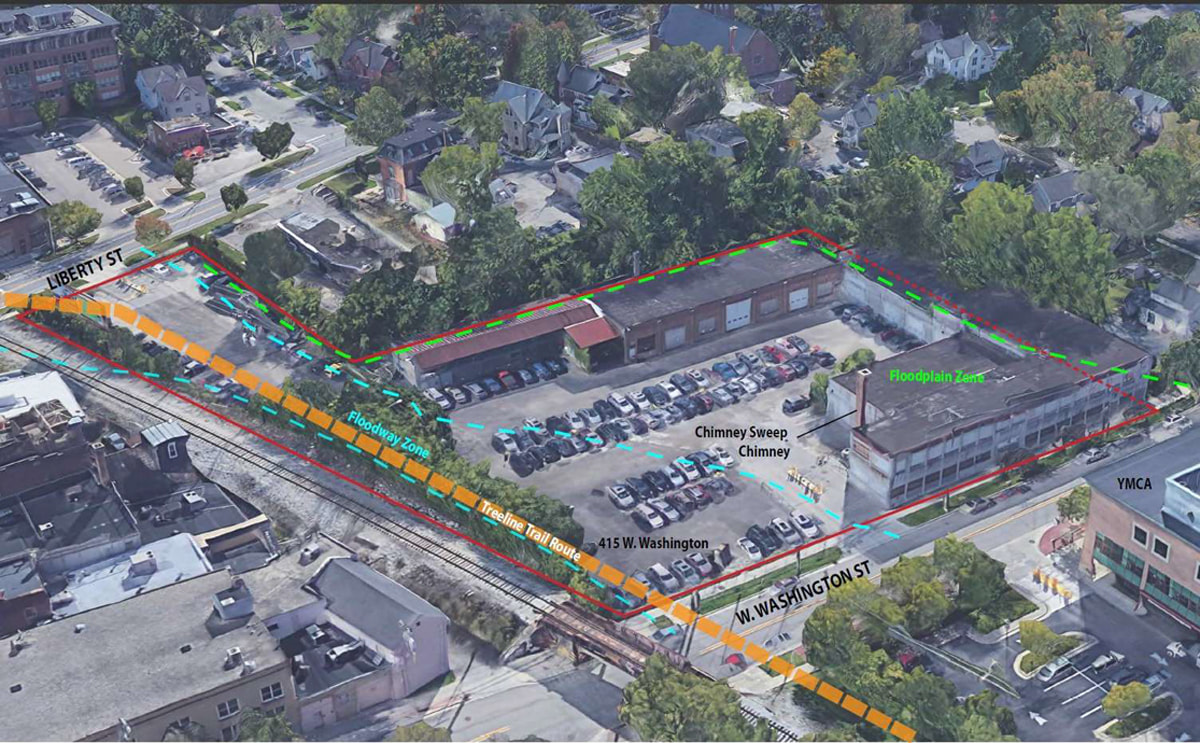
THE FUTURE OF 415 W. WASHINGTON What are those boarded up buildings and parking lot on W. Washington Street across from the Y? Here is a little history taken from author Grace Shackman (The garage at the center of the greenway debate, Ann Arbor Observer, February 2007): 415 West Washington (415) sits within the Old West Side Historic District and within the Allen Creek Floodplain. The main brick building was built in 1925 for the Washtenaw County Road Commission (WCRC)—a simple concrete structure with offices above a garage. Three years later, the commission added a one-story workshop, and in 1930 the addition of a brick garage. The accessory sheds are associated with the WPA (Works Progress Administration) launched during the Great Depression. WCRC employees worked on the second floor of the main building doing surveying, engineering, bookkeeping, purchasing, and personnel. In 1965 WCRC moved out and The City of Ann Arbor took over 415. The offices were used for parks and recreation, forestry, parking, traffic engineering, and Fairview Cemetery, along with the sign shop and eventually expanded to include neighborhood parking regulations and "clean community" violations in the building. More than 40 years later in 2007 the City mostly moved out of 415 and discussions began about what would become of the City-owned site. Since the site sits in the Allen Creek Floodplain, in 2006 Mayor Hieftje appointed The Allen Creek Greenway Task Force to gather input from the community and discuss options for the 415 site and the two other publicly-owned sites in the Allen Creek Floodplain. The Task Force issued a report in March 2007, which summarized the context of each site and presented three options for each. Options for 415 included (1) removal of existing buildings and conversion of the entire site into green open space with an art park and an open performance plaza built on pervious surface materials; (2) adaptive reuse of the historic brick buildings to serve community needs, such as arts and performance space; and (3) removing the existing structures and building housing in the flood fringe section and keeping the floodway section as green open space. Many plans were put forth over the next decade which proposed creative adaptive reuse of the historic buildings, including by Kiwanis and the Arts Alliance. 415 W. Washington is in the floodplain. How does that impact development? Virtually the entire 415 site is in the Allen Creek Floodplain. Floodplains are natural features along creeks and rivers which carry and absorb excess water from those creeks and rivers during heavy rain events. Floodplains are composed of the floodway -which conveys the water from rain events, and the flood fringe - which conveys the excess overflow from extreme rain events. Modern sustainable practices prohibit the construction of new residential buildings in floodways and put restrictions on the construction of new buildings in the flood fringe. This is why the new Y is elevated. The easternmost portion of 415 (one-third of the total site) along the railroad tracks is in the floodway, where new residential buildings are prohibited, and therefore all of that portion is proposed to be incorporated into the Treeline Trail. The Treeline Trail, formerly called the Allen Creek Greenway, is an urban trail which follows the Allen Creek contour from the UM Athletic Campus to the point where the Allen Creek empties into the Huron River on N. Main Street. It will connect with the county-wide Border-to Border Trail. The rest of the 415 site (two-thirds of the total) is in the flood fringe. 415 W. Washington is in the Old West Side Historic District. How does the Historic District Commission view this site? In 1990, the Old West Side Historic District Study Committee Report ruled that the current buildings and accessory structures are contributing structures to the OWS Historic District. The HDC has included this contributing status in their motions for the approval of work since then, most recently in 2018. There have been no changes, only reaffirmations. As defined by the Secretary of the Interior, and adopted by the State of Michigan: “A contributing (historic) resource is one that adds to the historic association, historic architectural quality, or archaeological values for which a property is significant because it was present during the period of significance, relates directly to the documented significance, and possesses historic integrity.” Although, in Spring of 2015, money had been allocated to repair the structures, most of it was not used and the City allowed the buildings to deteriorate. The cost of renovation has been cited as reason to bring the buildings down rather than renovate. Those who live in the Old West Side Historic District must follow strict guidelines to renovate their homes and businesses, and spend the extra money to stay compliant with HDC guidelines. The City should be held to those same standards; it is an investment in the future for both the neighborhood and the City. But, on September 20, 2018, at the request of the City, the HDC approved the demolition of the current structures in order to clear the way to develop the property. What does that mean? What about our sustainability goals? This approval does not mean the City is required to demolish the buildings. It only offers the option. Keeping and renovating the historic buildings on the 415 W. Washington site, with the use of sustainable materials, would be much more environmentally friendly than demolishing them, putting the materials in the landfill, and building new. Repurposing and renewing this site would fit in with the City’s A2Zero Climate Action Plan. Remember that the greenest building is one that already exists. (See the groundbreaking study, The Greenest Building: Quantifying the Environmental Value of Building Reuse, Preservation Green Lab of the National Trust for Historic Preservation, January 2012.)
What would that look like? The area surrounding 415 has recently been designated a Creative District by the DDA. We support preserving, renovating and repurposing the existing buildings for creative purposes, while building a modest number of housing units outside of the floodplain in the SW corner off W. Liberty. This would provide much-needed artist/small business studios, meeting areas, small shops, pop-up food stalls, and greenspace — and protect the Chimney Swifts as well. (More about the Chimney Swifts below!) Artist studios and small food shops would replace what was lost when the old Tech Center/Performance Network on Third and W. Washington was demolished to make way for the new Y, and when South Main Market was demolished to make way for the large multi-unit residential development, The Yard, on S. Main between Madison and Mosley. The one third of the site that is in the floodway can remain open and green and be wholly dedicated as an anchor park (as was originally planned) — a pleasant stop along the Treeline Trail -- a place for residents of the surrounding developments and people from all over the city to come to relax and visit with their friends and neighbors. Environmental educational features can be incorporated into the site, particularly information about the function of floodplains as a natural conveyance of stormwater, and information about the near-endangered Chimney Swifts and what they need to survive. What is this about the Chimney Swifts? The brick chimney at 415 is heavily used by Ann Arbor’s Chimney Swifts, a species classified as Near Threatened in the U.S. and Endangered in nearby Canada. Chimney Swifts are unable to perch in the way typical songbirds do. Instead, they have adapted to cling to rough vertical surfaces. Historically they roosted in the hollows of large trees, but when the forests were cut and so many landmark trees in urban areas disappeared, the Chimney Swifts turned to chimneys as substitutes for tree hollows. Now, as old chimneys are torn down, capped, or lined with metal, they find fewer places to roost and build nests to raise their young. This loss of habitat is among the factors threatening their continued existence. In spring, the Swifts arrive and build nests in chimneys. In late summer and fall, large groups gather in chimneys in preparation for their annual migration south. Around dusk, one can see hundreds spiraling around the chimney at 415 before they swoop down into the chimney for the night. Washtenaw Audubon has recently counted 1,400 Swifts swooping down into the chimney at 415 at dusk on a fall evening.
What is the "Preferred Option" the City of Ann Arbor is putting forward? Does it have affordable housing? The City has put several options before the public for comment and chose a “preferred option” butthis was under the false pretense of adding affordable housing. Additionalaffordable housing in Ann Arbor is on everyone’s agenda, but the reality is that the 415W. Washington site is in the floodplain and also in close proximity to the railroad tracks, which excludes the site from federal Low-Income Housing Tax Credits (LIHTC) and other federal subsidies for low-income housing as well as any monies from the recently passed affordable housing millage. Affordable housing is not an option on this site. Again, no new construction in the floodplain will qualify for federal subsidies or funds from the affordable housing millage. Both the City Planner and Affordable Housing Director have stated that, with the cost of demolishing the current buildings, cleaning upthe ground contaminants and developing the site, it is unlikely there would be funds left for the developer to donate to the Affordable Housing Fund. The good news is that the City has designated several other locations not far from 415 as suitable for affordable housing, because those sites do qualify for federal Low Income Housing Tax Credits and the local Affordable Housing Millage funds. There are already many existing and proposed housing developments in the downtown area andon the edges of the Old West Side, but 415 W. Washington is the only one actually within the Historic District of the Old West Side. This is a key consideration. It is important that more attention is paid to this fact. What are the next steps? The fate of 415 W. Washington is in our hands. Will it be demolished to become yet another nondescript luxury housing development without affordable housing, creating a looming barrier between the nearby neighborhood and downtown? Or will it be preserved and renovated to become a one-of-a-kind, community-enhancing site thatbeautifully transitions from downtown to the Old West Side neighborhood, while respecting the natural function of the floodplain and protecting the endangered Chimney Swifts? Imagine…something the entire city can enjoy! We ask the City to consider an alternate plan for adaptive reuse of the existing buildings.